





Eye For Film >> Movies >> Posthouse (2025) Film Review


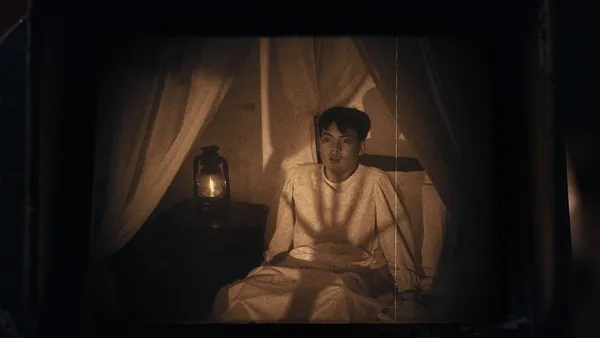

Posthouse, which screened as part of Halloween Frightfest 2025, is the first film as director for seasoned editor Nikolas Red. It has a distinctive quality that seems to speak to this, a narrative which has developed not as a linear progression but more like a puzzle assembled after the fact. This gives it a rigidity that evokes Greek tragedy and a complexity that will delight horror fans tired of simple scares.
With an eye of the colonial history of the Philippines, Red pieces together the story of several generations of a family whose lives have been inextricably wound up with the country’s developing film industry. The present day action focuses primarily on Cyril (Sid Lucero), a once ambitious man who now makes use of his talents in the advertising industry. A history of alcohol problems and a broken marriage have distanced him from his daughter Rea (Bea Binene), but now that she’s a film student herself, they have a chance to reconnect. She can serve as his assistant and thus accrue the hours of practical experience that she will need to graduate.
The careers of both father and daughter are overshadowed by their famous progenitor, HN Anderson, an industry pioneer who, despite whispers of scandal, remains a venerated figure. At around the same time that they begin working together, Cyril inherits a reel of film which might enable him to reassemble Anderson’s lost masterpiece, Ang Mananaggal, believed to be the country’s first ever silent film. They’re both excited by the prospect, which Cyril is determined they will approach properly, using traditional cutting and splicing techniques. Rumour has it, however, that the film is cursed.
Rooted in the real cinematic history of the country, the film uses its generational structure to explore technological change and the shifting relationship between filmmakers, films and viewers. It also probes Cyril’s past, unearthing a history of trauma associated with his father’s obsession and his own buried memories. Fact, in-world reality, folklore and fantasy intersect, yet the story remains character-driven, as Rea tries to connect with a father whose behaviour can be erratic whilst Cyril tries to distinguish his own world from the fictional one that intersected with his childhood. in the flickering snippets of old film that he watches again and again, the haunting figure on the mananaggal stretches her wings, moving inexorably closer, and one might find oneself wondering what made her this way.
In a break from work, Rea explains the Kuleshov effect to hardworking but less talented assistant Jeff. Take three images, say: a gun, a man screaming and a man running away. How you interpret the story they tell will depend on the order in which they appear. The magic is in the edit. But what does that mean when a story is in large part comprised of flashbacks which might have been accessed in any order? To what extent can we edit our interpretations of our own lives? And what might this mean for a country trying to move forward and express its own voice despite the weight of a difficult history?
Filmed in the backroom of an old studio full of archaic equipment, Posthouse is full of fascinating detail. Exposition is kept to a minimum, and though it may take you a while to make sense of the tangle of images, it’s worth the effort. In a key scene, a young boy lights his path with a glowing sword, its fictional background giving him courage. It’s a reminder that truths are further complicated by the very different ways we might perceive them at different stages in life. The light captured on celluloid or in digital form can be illuminating in many ways.
Reviewed on: 01 Nov 2025


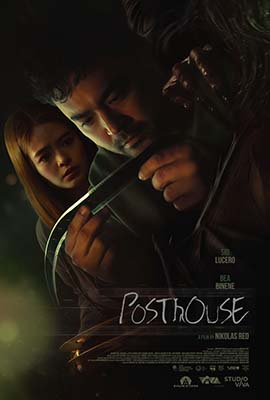
Director: Nikolas Red
Starring: Sid Lucero, Bea Binene, Andrea Del Rosario, Ryza Cenon
Year: 2025
Runtime: 94 minutes
Country: Philippines
Search database:
